Most Americans moving abroad pick their virtual mailbox based on price. Fifteen dollars a month here, twenty there — they open a Google tab, compare a few services, and click whichever has the nicest UI. That’s a $15,000 mistake. The state tied to your virtual mailbox expats US address state tax situation is not a logistical detail. It is a legal declaration of domicile — and in states like California, New York, and Illinois, that declaration can cost you tens of thousands of dollars in state income tax every single year you live abroad. This article breaks down what’s actually at stake, which states to use, which ones to flee, and exactly how to make the switch before you board that flight.
Why Your Mailbox State = Your Tax State
Here is the legal reality that mailbox companies do not advertise on their pricing page: when you register a US address through a virtual mailbox service, you are establishing — or maintaining — a legal domicile in that state. Domicile is not the same as residency. You can live in Portugal for a decade, never set foot in the US, and still owe state income tax to California if you never formally abandoned your California domicile.
Domicile is your permanent legal home — the place where, if you had no reason to be elsewhere, you would return. Residency is where you physically are. States tax based on domicile, not physical presence. That distinction is the entire game.
A virtual mailbox address in a high-tax state is not just a mailing convenience. Tax authorities treat it as evidence of continued domicile. Combined with other ties — a driver’s license, a car registration, a bank account, a brokerage account — a mailbox address becomes a thread in the rope that keeps you legally tethered to a state that can then tax your worldwide income, including foreign salary, dividends, rental income, and freelance revenue.
The concept of state tax nexus goes further: some states argue that simply receiving mail at an in-state address, maintaining professional licenses, or directing business activity into the state is sufficient to create a taxable connection — even for people who moved abroad years ago. Understanding domicile vs residency is not optional for expats. It is survival math.
The Three Expat-Friendly States: No Income Tax, No Long Arm
If you are choosing a virtual mailbox as an expat, you want a state that (1) has zero state income tax, (2) does not aggressively pursue former residents who move abroad, and (3) makes it straightforward to establish and maintain domicile without physically living there long-term. Three states check all three boxes: South Dakota, Florida, and Texas.
| State | Income Tax Rate | Domicile Requirement | Best For | Notable Downside |
|---|---|---|---|---|
| South Dakota | 0% | One night + state ID | Digital nomads, perpetual travelers | Very limited physical infrastructure |
| Florida | 0% | Driver’s license + Declaration of Domicile filing | Expats with US family ties, retirees | Must file Declaration of Domicile with county clerk |
| Texas | 0% | Driver’s license + voter registration | Business owners, those with US clients | Property tax is high (if you own property) |
South Dakota is the most popular choice for digital nomads and full-time expats, and for good reason. The state has no state income tax and requires only a single night’s stay to establish legal domicile — no 183-day requirement, no property ownership, no complicated paper trail. You show up, stay one night, get a South Dakota state ID or driver’s license, register your vehicle if applicable, and you have a legally defensible domicile. A South Dakota virtual mailbox address through services like America’s Mailbox (a Sioux Falls-based service popular with RVers and expats) completes the picture.
Florida domicile for expats is ideal when you have family, property, or business ties in the state already. Florida requires a bit more formality: you should file a Declaration of Domicile with your county clerk, get a Florida driver’s license, and register vehicles in the state. But for expats with existing Florida connections, it is the most natural and legally solid option. Florida has no state income tax and has historically avoided the aggressive audit posture of states like California.
Texas no income tax benefits are well-known, but Texas domicile for expats requires more documentation than South Dakota — you need a Texas driver’s license, vehicle registration (if applicable), voter registration, and ideally a Texas bank account. Texas is an excellent option for expats with existing Texas ties, business operations, or family there.
The States That Will Hunt You Down: California, New York, Illinois, and Virginia
If your virtual mailbox is registered in any of the following states and you are living abroad, you may be handing that state a legal claim to tax your entire worldwide income. These are not hypotheticals — these states have active audit programs specifically targeting former residents who moved abroad without properly terminating domicile.
California operates what tax professionals call a “long-arm” tax policy, and it is the most aggressive in the nation. The state income tax rate runs from 1% to 13.3% (with an additional 1% surcharge on income over $1 million, bringing the effective top rate to 14.4% on wage income). California’s Franchise Tax Board does not accept domicile abandonment without a preponderance of evidence. The FTB will look at where you receive mail, where your professional licenses are held, where your medical providers are located, where your social ties are strongest, and where your bank accounts are registered. A California mailing address is powerful evidence against you. The California long-arm tax reach means that even if you live in Thailand for ten years, if you cannot demonstrate a clean break from California domicile, the FTB can audit and assess tax on every dollar you earned abroad.
New York state tax nonresident rules are complex and punishing. New York has a top state income tax rate of 10.9% (for income over $25 million) with most middle-income earners in the 6–6.85% range. But the real trap is New York’s “statutory resident” rule: if you maintain a permanent place of abode in New York — which courts have interpreted broadly to include apartments you keep “just in case” — and you spend more than 183 days in New York in a year, the state taxes you as a full resident on worldwide income regardless of your domicile. Keep a New York mailing address, keep a New York bank account, spend a summer visiting family, and New York can claim you owe full resident taxes for that year.
Illinois has a flat income tax rate of 4.95% — not the highest, but the state has been known to pursue former residents who maintain Illinois ties including mailing addresses. Virginia runs a graduated rate up to 5.75% and similarly tracks domicile connections carefully. Neither state is as aggressive as California or New York, but both have the legal tools to assess tax on residents who move abroad without a formal domicile change.
To put it in real numbers: an expat earning $120,000 in foreign income who is still considered a California domiciliary could owe roughly $11,000–$12,000 in California state income tax alone, on top of federal taxes. Over the course of two or three years abroad, that is $30,000–$36,000 paid to a state where you do not live, for no benefit. That is the real cost of picking the wrong mailbox state.
What “Establishing Domicile” Actually Requires — State by State
Domicile change is not automatic. You do not establish a new domicile simply by opening a virtual mailbox in South Dakota. You need to take affirmative legal steps in the new state and simultaneously cut ties with your old state. Here is what each of the three expat-friendly states actually requires to establish a legally defensible US domicile change:
| Requirement | South Dakota | Florida | Texas |
|---|---|---|---|
| Physical visit required | Yes — one night minimum | Yes — driver’s license in person | Yes — driver’s license in person |
| State ID / Driver’s license | Required | Required | Required |
| Voter registration | Recommended | Recommended | Strongly recommended |
| Declaration of Domicile filing | Not required | Required (county clerk) | Not required |
| Vehicle registration | Recommended if applicable | Required if applicable | Required if applicable |
| Bank account in state | Strongly recommended | Recommended | Recommended |
| Time to complete | 24–48 hours | 1–2 days | 1–2 days |
For South Dakota, the typical expat process involves flying into Sioux Falls, staying one night at a hotel (keep the receipt — it is evidence of your domicile establishment date), visiting the DMV for a state ID, registering to vote, opening a local bank account if you do not have one, and setting up a virtual mailbox at a South Dakota address. Services like America’s Mailbox in Rapid City and Dakota Post in Sioux Falls are used by thousands of expats and RVers specifically for this purpose.
Critically, you must also abandon your prior domicile. This means surrendering your prior-state driver’s license, re-registering any vehicles, updating your address with your bank and brokerage accounts, filing a final state tax return in your old state marked as “part-year resident,” and removing yourself from your prior state’s voter rolls. The abandoned domicile state is the one that will fight hardest to keep you — California in particular has been known to dispute domicile abandonment for years after departure, especially when an audit reveals ongoing ties.
The Top Virtual Mailbox Services for Expats (Compared)

Not all virtual mailbox services are equal for expats — and critically, not all offer addresses in the tax-friendly states you need. Here is how the major players compare on the dimensions that actually matter for your tax situation:
| Service | Starting Price/mo | SD Available | FL Available | TX Available | Key Feature |
|---|---|---|---|---|---|
| Anytime Mailbox | $9.99 | Yes | Yes | Yes | 2,500+ locations globally; most affordable entry point |
| PostScan Mail | $10.00 | Yes | Yes | Yes | 1,000+ US addresses; strong open-and-scan features |
| Earth Class Mail | $29.00 | Limited | Yes | Yes | Premium scanning quality; best for high-volume business mail |
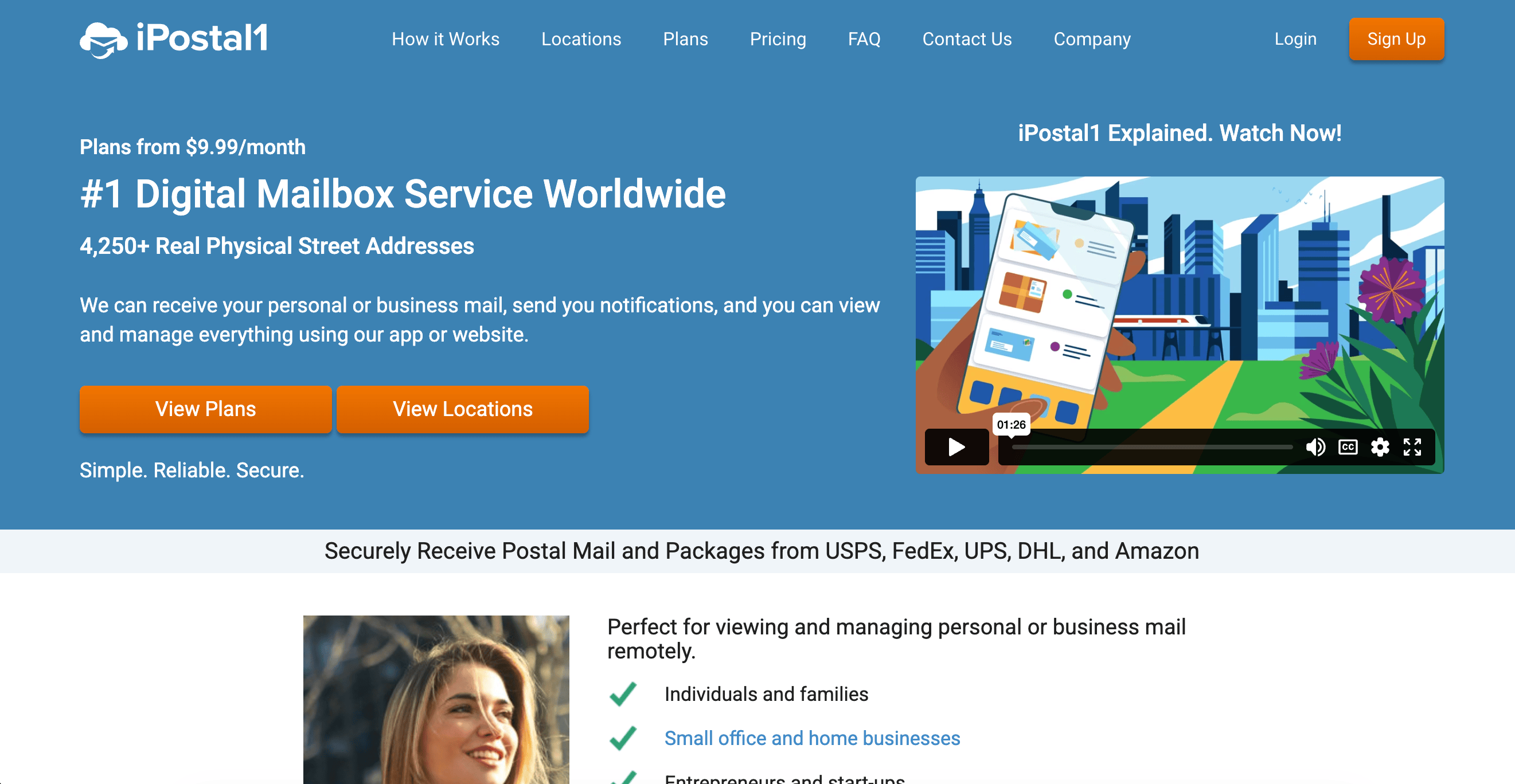
| iPostal1 | $9.99 | Yes | Yes | Yes | Real street addresses; strong mobile app |
| Traveling Mailbox | $15.00 | Yes | Yes | Yes | Unlimited mail items; popular with RVers and expats |
Anytime Mailbox is the most widely used service among expats, with plans starting at $9.99/month and over 2,500 locations including addresses in all three tax-friendly states. Their mobile app lets you view, forward, shred, or request scanning of any piece of mail. The base plan covers 30 incoming mail items and 5 open-and-scan pages per month — adequate for most individual expats.
PostScan Mail starts at $10/month (Starter plan) and offers 1,000+ addresses globally with strong scanning features. Their Standard plan at $20/month includes 60 mail items and 5 open-and-scan requests. For expats who receive moderate mail volume, PostScan Mail’s address selection in South Dakota, Florida, and Texas is solid.
Earth Class Mail is the premium option, with plans starting at $29/month for the Starter tier (2 recipients, 5 mail items) and $39/month for the Essentials tier (5 recipients, 25 items). Their scanning quality is best-in-class and check deposit features are strong. For expats running a US business entity, Earth Class Mail’s business-grade plans justify the higher cost.
One practical note: no matter which service you use, make sure the address is a real street address, not a P.O. Box. Many institutions — including banks, brokerage firms, and government agencies — will not accept a P.O. Box as a domicile address. A real street address is a non-negotiable requirement for establishing a legally defensible domicile.
The Step-by-Step Domicile Change Checklist Before You Leave

If you are planning to leave the US in the next 6–12 months, or if you are already abroad with a mailbox in a high-tax state, here is the precise sequence of actions to execute a clean domicile change. Do these in order — the sequence matters for establishing a clear legal timeline.
Step 1: Choose your new domicile state. For most expats with no existing ties to Florida or Texas, South Dakota is the fastest and simplest option. If you already have family, property, or business connections in Florida or Texas, use one of those instead.
Step 2: Open your virtual mailbox in the new state. Sign up for a service like Anytime Mailbox or PostScan Mail and select an address in your chosen state. This becomes your official US mailing address going forward. Get a real street address, not a P.O. Box.
Step 3: Visit your new domicile state in person. Book a trip before you depart. Stay at least one night (keep all receipts). Go to the DMV and obtain a new driver’s license with your virtual mailbox address. Register to vote. If you have a vehicle, register it in the new state.
Step 4: File a Declaration of Domicile (Florida only). If you chose Florida, visit the county clerk’s office and file a Declaration of Domicile document. This is a legal filing that creates a clear record of the date you established Florida domicile — it is strong evidence in any future audit dispute.
Step 5: Update all financial accounts. Change the address on your bank accounts, brokerage accounts (including any IRA or 401(k) providers), and any US business accounts to your new virtual mailbox address. These institutions report your state of record to tax authorities — getting them aligned with your new domicile is critical.
Step 6: Surrender your prior-state driver’s license and update voter registration. Do not keep an active driver’s license in your old state. Remove yourself from the voter rolls. These are two of the strongest indicators tax authorities use to determine domicile.
Step 7: File a part-year resident return in your old state. For the year you leave, file a part-year resident return in your former state, marking yourself as a nonresident from your departure date. This creates a clean legal record that you terminated domicile on a specific date. Consult a tax professional — especially if you are leaving California, New York, or Illinois — before filing this return.
Step 8: Document everything and keep records for at least 7 years. Hotel receipts from your domicile-establishment visit, DMV confirmation, lease agreements in your new country, utility bills abroad, and your new country’s tax identification documents all serve as evidence of your domicile change if you are ever audited. California in particular has been known to audit former residents up to 4 years after departure — sometimes longer if they suspect fraud.
The Bottom Line: This Is a Financial Decision, Not a Logistics One
Your virtual mailbox is not a $15/month administrative convenience. It is a legal instrument that tells US tax authorities where you live. Pick the wrong state — or fail to formally change domicile from a high-tax state — and you are handing California, New York, or Illinois a claim to your foreign income that could persist for years and cost you more than a round-trip flight to Sioux Falls every single month.
The fix is not complicated, but it requires intentional action. Choose South Dakota, Florida, or Texas. Make the trip. Get the license. File the paperwork. Update your accounts. Cut the ties with your old state cleanly, on a documented date. The entire process costs you a few hundred dollars in travel and professional fees. The alternative — doing nothing and hoping a high-tax state does not come looking — is the actual expensive option.
Before you move, this decision deserves as much attention as your visa, your housing, and your budget. It is a virtual mailbox expats US address state tax decision — and getting it right protects every dollar you earn, every year you live abroad.
Ready to start your exit plan? Download the FundYourExit Exit Planning Checklist and get a step-by-step guide to every financial decision you need to make before you leave — including domicile changes, banking, investing abroad, and cutting your US tax bill to zero.