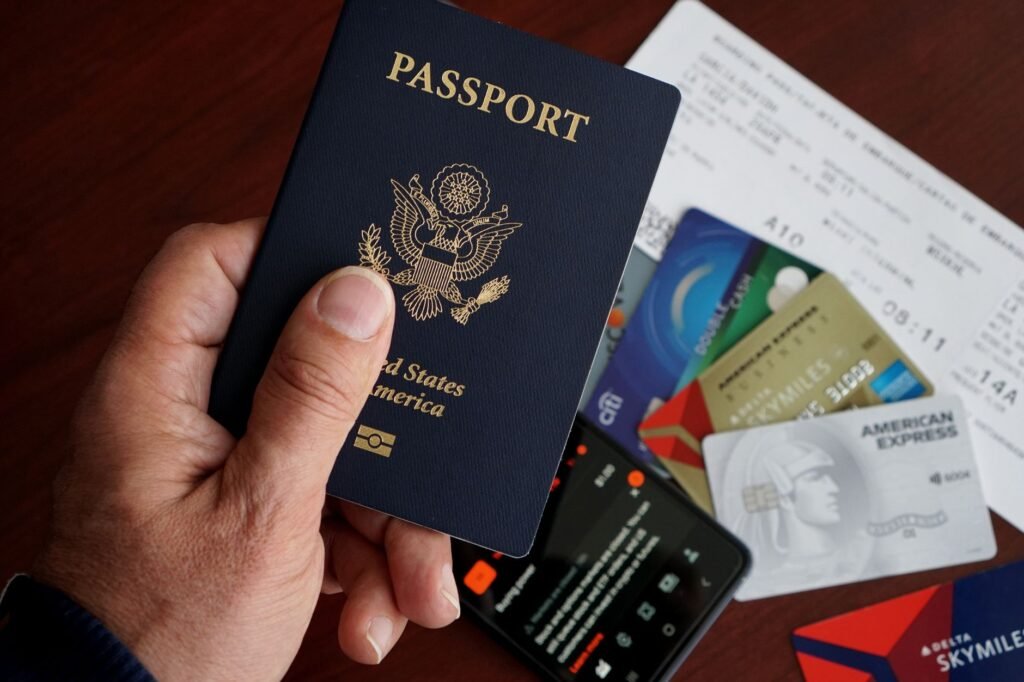
You found the apartment. You researched the visa. You’ve watched every YouTube video about Bali, Lisbon, and Medellín. But there’s a category of “move abroad” prep that almost every influencer skips — the financial infrastructure work that will make or break your life overseas. If you leave the U.S. without doing this work, you’ll spend your first six months abroad stressed about money instead of actually living the life you planned.
This isn’t a checklist of things to “look into.” These are 11 concrete financial steps — the ones that matter — and exactly how to execute each one before you board that plane.

1. Establish Domicile in a No-Income-Tax State Before You Leave

This is the single most financially impactful step on this entire list, and most people blow past it without a second thought. When you move abroad, you still need a legal U.S. domicile — a home state for your driver’s license, banking, voting, and taxes. If you let that default to whatever state you currently live in, you could owe state income tax on your foreign-earned income even while living in another country.
The five states with no income tax are South Dakota, Florida, Texas, Nevada, and Wyoming. Of those, South Dakota and Florida are the most popular among long-term expats and digital nomads because they have clear, well-established processes for establishing domicile without actually owning property. For South Dakota, you can stay one night at any address — a motel counts — register your vehicle, get a SD driver’s license, and you’re done. Florida requires a bit more paperwork but is equally expat-friendly.
Do this before you leave. Once you’re abroad, changing your domicile gets complicated and California, New York, and other high-tax states are notoriously aggressive about claiming residents who moved “temporarily.” Cut that tie cleanly while you’re still on U.S. soil.
2. Open a Schwab or Fidelity International Brokerage Account

Your current bank will rob you abroad. Foreign transaction fees of 1–3%, ATM fees of $3–5 per withdrawal, and terrible exchange rates add up to hundreds or even thousands of dollars per year. The fix is straightforward: open a Charles Schwab High Yield Investor Checking account or a Fidelity Cash Management Account before you leave.
Both accounts reimburse all ATM fees worldwide — every single one — and neither charges foreign transaction fees. Schwab is particularly popular among expats because there’s no minimum balance, no monthly fees, and you can open the account entirely online. The debit card works at virtually every ATM on the planet and you’ll get reimbursed at the end of each statement cycle.
One critical note: open these accounts while you still have a U.S. address. Many banks won’t open new accounts for customers who list a foreign address. Get it set up, fund it with at least a month’s worth of living expenses, and link it to your existing accounts before departure day.
3. Get a Wise or Revolut Multi-Currency Account

Schwab or Fidelity handles your ATM cash. Wise or Revolut handles everything else — paying local vendors, receiving money in foreign currencies, and making international transfers without getting crushed by exchange rate markups.
Wise converts currencies at the mid-market rate (the real exchange rate, the one you see on Google) with a small transparent fee, typically 0.4–1.5% depending on the currency pair. You can hold balances in 50+ currencies, receive money with local bank details in the U.S., UK, EU, Australia, and more, and send money to local bank accounts overseas. If you’re freelancing or running a business abroad, Wise becomes your payment hub.
Revolut offers similar features with some additional perks — cryptocurrency exchange, budgeting tools, and premium tiers with better limits — but has had some customer service complaints. Most expats use both: Wise for transfers and receiving income, Revolut as a backup and for travel perks. Set them both up before you leave. Verification is easier when you still have U.S. documentation readily at hand.
4. Check Your Student Loan Repayment Plan and Switch to IBR or SAVE

If you have federal student loans, moving abroad doesn’t make them disappear — but it can dramatically reduce what you owe monthly. The key is switching to an income-driven repayment plan before you leave, specifically Income-Based Repayment (IBR) or the newer SAVE plan (Saving on a Valuable Education), which calculates your payment as a percentage of your discretionary income.
Here’s where it gets interesting: if you’re living abroad and claim the Foreign Earned Income Exclusion (more on that in Step 8), your taxable U.S. income could be dramatically reduced — potentially to zero. Income-driven repayment payments are based on your Adjusted Gross Income. If your AGI is low or zero after FEIE, your monthly student loan payment could drop to $0 legally. That’s not a loophole — that’s the system working exactly as designed.
Log into studentaid.gov now and switch your plan before you leave. You’ll need to recertify your income annually, which you can do remotely. Set a calendar reminder so you never miss recertification and accidentally get bumped back to standard repayment.
5. Decide What to Do With Your U.S. Credit Cards — Keep Them Open

The worst thing you can do before moving abroad is cancel your U.S. credit cards. Your credit history is one of your most valuable financial assets, and closing accounts will tank your score by reducing your available credit and shortening your average account age. When you eventually return to the U.S. — or need to finance anything that requires a U.S. credit check — you’ll regret it.
Instead, here’s the actual move: keep your cards open and active. Use each card for one small recurring charge — a streaming subscription, your VPN, a monthly donation — and set it to autopay from your Schwab or Fidelity account. This keeps the cards active, builds your payment history, and costs you nothing if you’re not carrying a balance.
Before leaving, call each card issuer and notify them that you’re traveling long-term internationally. Ask to have any annual fees waived or request product changes to no-fee versions if you don’t use the travel benefits. Chase Sapphire, Amex Gold, and Capital One Venture all have travel protections that may still be valuable as an expat — review the benefits and keep the ones that work for your new life.
6. Set Up a U.S. Mail Forwarding Service

You will still receive mail. IRS notices, bank statements, jury duty summons, insurance renewal letters — the postal system does not care that you live in Southeast Asia now. You need a U.S. mailing address that actually works, which means a virtual mailbox service, not a friend’s couch or your parents’ house.
The two best options are Traveling Mailbox and PostScan Mail. Both assign you a real U.S. street address (not a P.O. box, which many financial institutions won’t accept), scan the exterior of every piece of mail, and let you request digital scans of the contents on demand. You can forward physical mail internationally when needed or shred anything you don’t need. Prices run $15–25/month and are absolutely worth it.
Set this up at least 30 days before you leave. Update your address with your bank, brokerage, the IRS, and any subscriptions before departure. This address should match the domicile state you established in Step 1 — so if you’re domiciling in South Dakota, use a virtual mailbox with a South Dakota address.
7. Sort Your Health Insurance Before and After Departure

Health insurance is where expat planning gets complicated fast. Here’s the cleanest approach: if you’re leaving partway through the year, maintain your ACA (Affordable Care Act) marketplace coverage through your departure month. You’re still a U.S. resident for that portion of the year, and going uninsured — even briefly — creates coverage gaps and potential tax penalties.
Once you’re officially living abroad, you have two primary options. SafetyWing Nomad Insurance is the entry-level choice — starting around $45–60/month depending on your age — and covers emergency medical care, hospital stays, and emergency evacuation in most countries. It does not cover routine or preventive care, making it suitable for healthy people in their 20s and 30s who want catastrophic coverage at a low price point.
Cigna Global, Allianz Care, and Aetna International offer comprehensive expat health insurance with routine care, mental health, dental, and vision add-ons. These plans run $200–600+/month but provide coverage equivalent to what you’d have in the U.S. If you have ongoing health needs, take prescription medications, or want to access quality private healthcare in your destination country, comprehensive expat insurance is worth the cost. Compare plans on Pacific Cross or William Russell before committing.
8. File for the Foreign Earned Income Exclusion (Form 2555) Once Abroad

The Foreign Earned Income Exclusion (FEIE) is the most valuable tax benefit available to U.S. expats and one of the most underutilized. In 2024, the exclusion allows you to exclude up to $126,500 of foreign-earned income from U.S. federal income tax. In 2025 and 2026, that number adjusts upward with inflation. For most expats earning under six figures, this means a federal tax liability of zero on their employment or self-employment income earned abroad.
To qualify, you must meet either the Physical Presence Test (330 full days outside the U.S. in any 12-month period) or the Bona Fide Residence Test (being a bona fide resident of a foreign country for an uninterrupted period including a full calendar year). You claim the exclusion by filing Form 2555 with your annual U.S. tax return.
This is not something to set up before you leave — you can only file it after you’ve met the qualifying time requirements. But you should understand how it works before departure, track your travel days meticulously from day one, and work with an expat-specialized CPA (look for firms like Greenback Expat Tax Services or Taxes for Expats) who files these returns regularly. A general-practice accountant who doesn’t specialize in expat taxes will cost you money through missed exclusions and credits.
9. Settle or Restructure Any Outstanding Debts

Moving abroad does not make debt go away. It just makes it harder to manage and potentially more expensive. Credit card balances at 20%+ APR will compound aggressively while you’re distracted with the logistics of a new country. Personal loans with variable rates can change without you noticing. Medical debt can go to collections while you’re off the grid.
Before you leave, do a complete debt audit. List every liability — credit cards, personal loans, medical debt, car payments, any money owed to individuals — with the balance, interest rate, and minimum payment. Your priority order: anything in collections (settle before departure), high-interest credit card debt (pay down aggressively or transfer to a 0% balance transfer card), and then everything else based on interest rate.
If you can’t pay off high-interest debt before leaving, at minimum set up autopay on everything so you never miss a payment. A 30-day late payment can drop your credit score by 100 points and stays on your report for seven years. The cost savings of living abroad should be applied toward debt elimination — treat it as your primary financial mission for the first 12–24 months of expat life if your balance sheet isn’t clean.
10. Transfer or Roll Over Retirement Accounts If Needed

If you’re leaving an employer, you’ll need to decide what to do with your 401(k) or 403(b). You have four options: leave it where it is, roll it into your new employer’s plan (if applicable), roll it into an IRA, or cash it out. Cashing it out is almost always the wrong choice — you’ll owe income tax plus a 10% early withdrawal penalty if you’re under 59½, which could mean losing 30–40% of the balance in taxes immediately.
The cleanest move for most expats is a direct rollover from your 401(k) into a Traditional IRA at Schwab or Fidelity (the same institution where you opened your international checking account). This consolidates your U.S. retirement assets under one roof, gives you broader investment options than most employer plans, and has no immediate tax consequences if done as a direct rollover.
Once abroad, you can continue contributing to a Roth IRA with earned income — but only if your income exceeds your FEIE exclusion amount. If the FEIE wipes out all your U.S. taxable income, you technically have no earned income to contribute to an IRA. This is a known trade-off between FEIE and retirement contributions — worth discussing with your expat CPA to decide which benefit is larger in your specific situation.
11. Have a 6-Month Emergency Fund in USD Before You Go

Six months of expenses in USD, in a high-yield savings account, before you board that plane. Not three months. Not “I’ll build it up once I get there.” Six months. This is the rule and it is non-negotiable for anyone making a serious long-term move abroad.
Here’s why the number needs to be higher than you think: your first few months abroad will have unexpected costs. A visa that takes longer and costs more than expected. A security deposit plus first and last month’s rent. A medical situation. A flight home for a family emergency. An income gap while you find clients or transition to remote work. These are not rare catastrophes — they are normal parts of the transition, and they cost U.S. dollars even when your everyday spending is in local currency.
Keep this fund in a U.S. high-yield savings account — Marcus by Goldman Sachs, Ally, or SoFi all currently offer 4%+ APY — not in your checking account where it’ll get spent, and not in a brokerage account where a market downturn could cut it in half right when you need it most. This is your financial runway. It’s what turns a setback into an inconvenience instead of a crisis.
The Bottom Line: Do the Boring Work Before It Gets Exciting
Every step on this list is less glamorous than choosing your destination city or planning your first weekend trip. None of it will end up in your Instagram stories. But this is the infrastructure that makes the lifestyle actually sustainable — the difference between someone who moves abroad and thrives for years versus someone who moves abroad and crawls back to the U.S. six months later because the financial foundation wasn’t there.
Start with domicile and banking — those two alone will save you thousands per year. Work through the list methodically. Give yourself at least 60–90 days before your departure date to complete all 11 steps without rushing. And if you’re not sure where to start, begin with Step 1. Everything else builds from there.
The exit is the easy part. The financial checklist is what makes it last.